

What if the most sophisticated tool for restoring your hair density wasn’t a synthetic chemical, but a biological resource already flowing through your veins? It’s natural to feel a sense of hesitation when navigating the crowded market of hair loss treatments, especially when you’re seeking results that look authentic rather than manufactured. You likely want to avoid invasive surgery while finding a solution that’s grounded in real science. At Bella Complexion, we provide professional PRP hair treatment Toronto NSW locals can rely on, delivered within a clinical environment where your safety is managed by a registered nurse with over 30 years of experience.
You’ll discover exactly how we use the concentrated growth factors in your own plasma to revitalise dormant follicles and improve visible hair thickness. This guide explains the biological mechanism behind Platelet-Rich Plasma and outlines the professional standards that ensure your journey toward hair restoration is both transparent and effective.
Key Takeaways
- Understand how autologous growth factors from your own blood work to revitalise dormant follicles and promote natural hair density.
- Learn why a nurse-led PRP hair treatment Toronto NSW provides a higher standard of clinical safety and precision compared to non-medical settings.
- Discover how bio-stimulation extends the Anagen growth phase of your hair cycle to help maintain thickness over time.
- Determine if you are an ideal candidate for regenerative therapy based on the stage of your hair thinning and your overall health profile.
- Gain a clear understanding of the professional consultation process and what to expect during a medical-grade hair restoration session.
Understanding Platelet-Rich Plasma (PRP) for Hair Restoration
Platelet-Rich Plasma (PRP) isn’t a new discovery; it has a long history in sports medicine and orthopaedics where it was used to accelerate the healing of tendons and ligaments in elite athletes. Over time, clinical researchers recognised that these same regenerative properties could be applied to aesthetic medicine, specifically to address the cellular health of hair follicles. For those seeking a comprehensive overview of Platelet-Rich Plasma, it’s helpful to understand its evolution from a wound-healing accelerator to a cornerstone of regenerative aesthetics. At Bella Complexion, we’ve integrated this technology to offer a professional PRP hair treatment Toronto NSW residents can access for natural, long-term hair density.
Because the treatment is autologous, meaning it’s derived entirely from your own biology, the safety profile is exceptionally high. There’s virtually no risk of allergic reaction or rejection because we aren’t introducing foreign chemicals or synthetic compounds into your scalp. We’re simply taking what your body already uses to heal itself and concentrating it where it’s needed most. This biological approach provides a sense of security for many clients who feel overwhelmed by the complex ingredient lists found in some topical hair loss products.
What exactly is PRP?
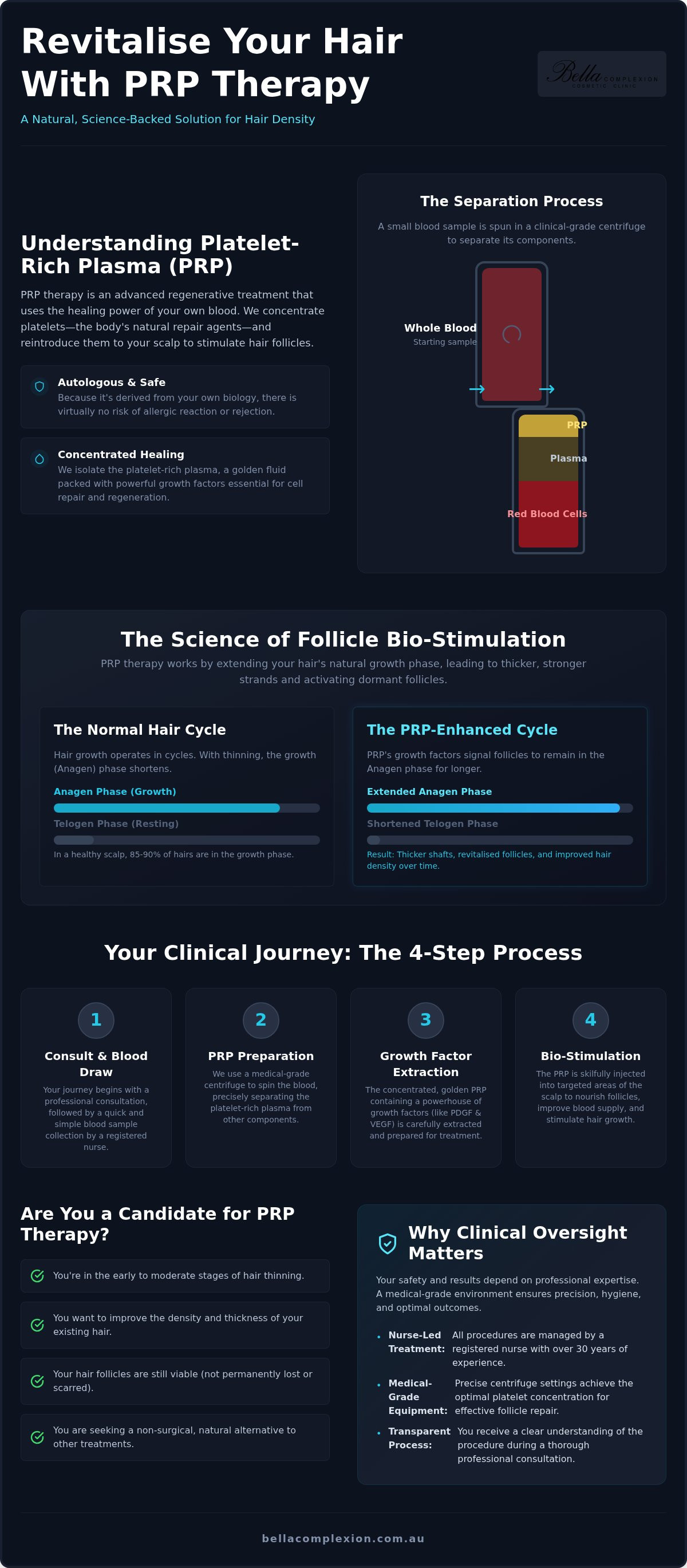
Platelet-Rich Plasma is a therapeutic concentration of platelets suspended in a specific volume of plasma, prepared using a sample of your own blood. We collect a small amount of blood and place it into a clinical-grade centrifuge, which spins the sample at high speeds to separate the red blood cells from the nutrient-rich plasma. It’s vital to use medical-grade equipment during this phase. The precise speed and duration of the spin determine whether we achieve the optimal platelet concentration required to trigger follicle repair effectively.
Why platelets are the engine room of hair growth
While platelets are well-known for their role in blood clotting, they also house a powerhouse of growth factors, including Vascular Endothelial Growth Factor (VEGF) and Platelet-Derived Growth Factor (PDGF). These proteins act as a biological “wake-up call” for dormant hair bulbs and miniaturised hairs that have stopped producing thick, healthy strands. By injecting these concentrated factors directly into the scalp, we stimulate bio-regeneration at the cellular level. This process improves the local blood supply and ensures a steady delivery of nutrients to the follicles, helping to reverse the thinning process and restore hair density from the inside out.
The Science of Follicle Bio-Stimulation and Hair Density
Hair doesn’t grow in a constant, linear fashion. Instead, it operates in distinct cycles. The Anagen phase is the active growth stage, while the Telogen phase represents the resting period before the hair eventually sheds. In a healthy scalp, roughly 85% to 90% of hairs are in the Anagen phase at any given time. However, conditions like androgenetic alopecia disrupt this balance, shortening the growth window and leading to thinner, weaker strands. According to the American Hair Loss Association on PRP, regenerative therapies aim to reset this biological clock. By introducing concentrated platelets, we signal the follicle to remain in the Anagen phase for longer, allowing the hair to reach its full potential in both length and diameter.
PRP hair treatment Toronto NSW protocols focus on two primary outcomes within our clinical setting. First, we aim to thicken existing hair shafts. When a follicle miniaturises, it produces “vellus” hair, which is the fine, peach-fuzz type that lacks pigment and strength. PRP provides the nutritional and hormonal support required to re-size these follicles, returning them to a state where they produce robust, terminal hair. Second, it can activate dormant follicles that have recently entered an extended resting phase, provided the follicle remains viable. This dual action is why we view Platelet-Rich Plasma as a foundational element of regenerative medicine for the scalp.
How PRP reverses hair thinning
Pattern thinning occurs when follicles become increasingly sensitive to hormonal changes, causing them to shrink over time. This miniaturisation is a progressive process that eventually leads to the follicle losing its ability to produce hair entirely. The earlier you intervene with bio-stimulation, the more significant your clinical outcomes will be. Once a follicle has completely scarred over or remained inactive for many years, the regenerative signal is less effective. This is why we advocate for a proactive approach during the initial stages of thinning to preserve your natural density.
PRP vs Exosomes: A modern comparison
While PRP uses your own living cells, exosomes represent a different frontier in signalling technology. Exosomes aren’t cells themselves; they’re microscopic messengers that carry specific proteins and growth factors to trigger repair in surrounding tissue. When comparing the two, PRP is a completely autologous, “closed-loop” system using your own blood. Exosomes are often derived from donor sources or lab-refined to provide a potent, high-concentration signal. We often discuss these differences during our acne scar treatment Lake Macquarie consultations, as the choice between them depends on the specific regenerative needs of your scalp or skin.
If you’re unsure which biological approach best suits your current hair density, arranging a clinical assessment is the most reliable way to create a tailored plan for your long-term scalp health.
Are You a Candidate for PRP Hair Therapy?
Experiencing hair thinning can be a deeply personal and often distressing journey. It affects self-confidence and can make you feel as though you’re losing a part of your identity. Because we understand the emotional weight of these changes, we prioritise a compassionate, clinical assessment for every person considering PRP hair treatment Toronto NSW. Not everyone is a suitable candidate for this specific biological therapy; identifying the right starting point is essential for achieving the outcomes you desire.
Safety is our foundation. While Platelet-Rich Plasma is autologous and generally very safe, certain medical conditions may preclude you from treatment. We look for contraindications such as active scalp infections, chronic liver disease, or specific blood disorders like thrombocytopenia, which is a low platelet count. If your body cannot produce a healthy concentration of functional platelets, the treatment won’t deliver the regenerative signal required for follicle repair. This is why a professional consultation in our Toronto clinic is the first step toward a safe and effective plan.
Identifying the right stage of hair loss
We use established clinical frameworks like the Norwood Scale for men and the Ludwig Scale for women to determine your level of thinning. PRP is most effective for those in the early to moderate stages of hair loss where follicles are miniaturised but still active. If an area of the scalp is completely smooth and bald, the follicles have likely scarred over, meaning there is no “engine” left for the growth factors to restart. We approach these assessments with the same rigour as our wrinkle treatment protocols, ensuring we only recommend procedures that have a high probability of success for your unique biology.
Managing expectations: Clinical vs miraculous results
It’s important to view hair restoration as a steady journey rather than an overnight fix. A typical protocol involves a “loading phase,” usually consisting of three to four sessions spaced about four weeks apart. You won’t see a full head of hair after one appointment. Instead, you might notice a reduction in shedding within the first few weeks, followed by a gradual improvement in hair quality and density over three to six months. Maintenance sessions are generally required every six to twelve months to preserve the bio-stimulatory effects and keep those follicles in the active growth phase.
The Clinical Journey: What to Expect During Your Treatment
Your journey begins with a thorough consultation with a cosmetic nurse our patients in Toronto NSW and the surrounding areas trust for clinical integrity. During this initial meeting, we review your medical history and examine your scalp to ensure the protocol aligns with your goals. We believe in transparency; we’ll explain the process in detail so you feel confident before we begin. When you choose a PRP hair treatment Toronto NSW at Bella Complexion, you’re choosing a protocol refined by decades of medical experience. The procedure itself is performed in our sterile, medical-grade clinic, ensuring a level of safety that far exceeds a standard salon environment.
We follow a rigorous three-step protocol: Collect, Concentrate, and Communicate. First, we collect a small sample of your blood. Next, we concentrate the platelets using high-speed centrifugation. Finally, we communicate that biological signal back to your hair follicles through precise micro-injections. While the idea of scalp injections might sound daunting, we use fine-gauge needles and can apply topical numbing agents to ensure the experience is manageable. Most clients describe the sensation as a series of small pinpricks or a mild pressure rather than significant pain. We don’t believe clinical results should come at the expense of a stressful experience.
Step-by-step: From blood draw to scalp injection
The blood draw is identical to a standard pathology test you’ve likely had many times before. Once the sample is secured, it’s placed in our centrifuge to isolate the “liquid gold” plasma from the red blood cells. This concentrated serum is then prepared for the injection phase. We use a meticulous micro-injection technique, targeting the specific areas where thinning is most evident. The entire session typically lasts between 45 and 60 minutes, fitting easily into a standard day without the need for significant time away from your usual routine.
Post-treatment care and downtime
Downtime is minimal, but your scalp needs a short window to begin the regenerative process without interference. You might experience mild swelling or temporary tenderness for 24 to 48 hours. We provide a clear post-care checklist to ensure optimal results:
- Avoid washing your hair for at least 12 to 24 hours to let the injection sites heal.
- Refrain from using harsh chemical treatments, hair dyes, or styling products for one week.
- Steer clear of intense exercise, saunas, or hot showers for 48 hours to prevent irritation.
- Protect your scalp from direct sun exposure immediately following the session.
If you’re ready to experience a professional, nurse-led approach to hair restoration, you can book your clinical consultation online today and take the first step toward restoring your hair density.
Why Clinical Oversight Matters for Your Hair Restoration
When you’re considering a PRP hair treatment Toronto NSW, the environment in which you receive care is just as vital as the technology used. The aesthetic industry is often saturated with low-cost offers, yet these “bargain” treatments frequently lack the medical-grade protocols necessary for both safety and efficacy. At Bella Complexion, your care is led by Sue Willis, a registered nurse with over 30 years of clinical experience. This extensive background ensures that every step of your procedure, from the initial blood draw to the final micro-injection, adheres to the same rigorous standards found in high-stakes medical environments. We don’t view hair restoration as a simple beauty service; we treat it as a clinical intervention in your biological health.
Choosing a PRP hair treatment Toronto NSW at a nurse-led clinic means you’re investing in clinical oversight that prioritises your long-term wellness. A sterile, controlled environment is essential to prevent infection and ensure the integrity of the autologous plasma being reinjected. By maintaining these high standards, we provide a safe haven for clients who want professional results without the risks associated with non-clinical settings. We see ourselves as your partners in ageing gracefully, offering a grounded and honest perspective on what bio-stimulation can achieve for your hair density.
The importance of a nurse-led approach
Deep anatomical knowledge is non-negotiable when performing scalp injections. A clinician must understand the complex vascular structures and nerve pathways of the scalp to deliver growth factors precisely where they can stimulate the follicle without causing unnecessary trauma. Beyond the physical procedure, a nurse-led approach means your complete health history is reviewed with a professional eye. We look at the holistic picture of your health rather than just the thinning area. This level of clinical integrity replaces high-pressure sales tactics with evidence-based guidance, ensuring you feel like a patient under expert care rather than a customer in a salon.
Building a long-term hair health plan
Restoration isn’t a one-off event; it’s a commitment to your scalp’s biological vitality. We typically recommend a loading phase of three treatments to establish a strong regenerative signal, followed by a personalised maintenance schedule to preserve those gains. Many of our clients find that hair health is part of a broader wellness journey. For instance, there is a natural synergy between these therapies and other regenerative options, such as skin needling Toronto NSW, which we often use to address facial skin quality. We explore these differences further in our guide on PRP vs microneedling.
By viewing your hair restoration as a long-term strategy rather than a quick fix, you can achieve results that look authentic and sustainable. We invite you to begin this journey with a professional consultation, where we can map out a path that respects your unique biology and your aesthetic goals.
Take the First Step Toward Restoring Your Hair Density
Choosing to address hair thinning is a significant decision that requires both patience and professional guidance. By harnessing the regenerative power of your own platelets, you’re opting for a natural, evidence-based approach to stimulate follicle health and increase hair thickness. We’ve explored how Platelet-Rich Plasma works to extend the growth phase of your hair cycle and why early intervention remains the most effective strategy for preserving your natural density. This isn’t about quick fixes; it’s about a long-term commitment to your scalp’s biological vitality.
At Bella Complexion, we provide a safe, nurse-led environment where your treatment is overseen by Sue Willis, a registered nurse with over 30 years of clinical experience. This high standard of care ensures that every PRP hair treatment Toronto NSW protocol is delivered with medical precision and personalised attention. We’re here to help you navigate this journey with integrity and clinical expertise. If you’re ready to explore a biological solution for your hair thinning, we invite you to Book your clinical hair restoration consultation with Sue Willis. We look forward to supporting you in achieving a fuller, healthier head of hair.
Frequently Asked Questions
How many PRP sessions are needed for hair loss?
Most clients require an initial loading phase of three to four sessions to achieve optimal bio-stimulation. We typically space these appointments four weeks apart to align with the natural regenerative cycle of your follicles. After this primary phase, a maintenance session every six to twelve months is usually recommended to preserve your results and manage ongoing hair thinning.
Is PRP for hair loss permanent?
The results of Platelet-Rich Plasma therapy aren’t permanent because hair loss is often driven by ongoing genetic or hormonal factors. While the treatment effectively revitalises dormant follicles and increases density, the underlying biological process of thinning continues over time. Regular maintenance sessions ensure your follicles receive the sustained growth signals they need to stay in the active growth phase.
Does the PRP injection process into the scalp hurt?
Most patients describe the sensation as a series of mild pinpricks or a light pressure on the scalp. We use very fine, medical-gauge needles to minimise discomfort and can apply a topical numbing cream before we begin the procedure. Performing your PRP hair treatment Toronto NSW in a clinical setting ensures we prioritise your comfort and use techniques that make the experience quite manageable.
Can I go back to work immediately after PRP hair therapy?
You can usually return to your normal daily activities immediately after your session. There is no significant downtime, though you might notice some mild redness or a feeling of fullness in the scalp for a few hours. We simply ask that you avoid vigorous exercise, hot showers, or harsh hair products for the first 24 to 48 hours to allow the injection sites to heal undisturbed.
How much does PRP hair therapy cost in Newcastle?
The investment for hair restoration depends on the specific clinical protocol and the number of sessions required for your personalised plan. Because PRP is classified as a cosmetic procedure in Australia, it’s not covered by Medicare or private health insurance rebates. We provide a detailed breakdown of costs during your initial clinical consultation once we’ve assessed your stage of hair loss.
Are there any side effects to Platelet-Rich Plasma therapy for hair?
Side effects are typically minimal and temporary because the treatment uses your own biological material. You might experience slight swelling, tenderness, or minor bruising at the injection sites, which usually resolves within a day or two. Since we don’t use synthetic chemicals or donor tissues, the risk of an allergic reaction or rejection is virtually non-existent.
Can PRP be used alongside other hair loss medications?
Yes, Platelet-Rich Plasma is often used as part of a multi-faceted approach to hair wellness. It can complement topical treatments or oral medications by improving the local environment of the scalp and enhancing nutrient delivery to the follicles. It’s important to discuss any current medications during your assessment so we can ensure your hair restoration plan is safe and cohesive.
How soon will I see results from my PRP hair treatment?
Visible improvements in hair density and quality typically appear between three and six months after your initial loading phase. The first change many clients notice is a significant reduction in hair shedding during their daily routine. Because hair growth is a slow biological process, it takes time for the stimulated follicles to produce thicker, more robust strands that are visible at the surface.